Monday, May 24, 2010

A trip to Luxor

Last year on my way to the Cape Town Book Fair I missed my connecting flight in Joburg because of bad weather. I ended up missing the first day of the fair so when I finally got there I rushed to the first author talk going. It was South African writer Marie Heese reading from her novel The Double Crown, Secret Writings of a Female Pharaoh. I hardly knew anything about Egypt and its history but suddenly here was an intriguing novel about the female pharaoh Hatshepsut (Hat-shep-soot- more than anything I'm writing that pronunciation for me as I am struggling to keep it in my mind.). A little less than a year later I stood in her temple and had my photo taken next to her bearded statue. And who said life does not have a plan for us?
(Excuse the photo- my aim was coolness and comfort- I believe I have officially become a middle aged woman.)


Yesterday at 5am we set off for Luxor, a town along the Nile River. It's a fascinating drive as you head south along the Red Sea coast and then head west across the desert, passing through beautiful mountains.

Then suddenly like magic everything turns green. Bougainvillia and oleander bloom along the road and channels direct Nile river water to the rich dark soil in the tidy plots where crops grow.
Then we arrive in Luxor. The name is synonymous with the ancient Egyptian artifacts, the Valley of the Kings, but it is a town, large and modern, home to over 300,000 residents. In Botswana, many people build houses and then in the hope that more money will come and they will be able to extend it, they leave connecting bricks sticking off to the side where the next room can be added. Here people build upward, but with the same idea. The tops of many of the houses look unfinished, they are waiting for the money to build the next floor. Our tour guide, Marea, told us families often build flats for their children when they get married, on that unfinished roof. In the meantime it is a place to position the TV satellite or string the clothes line.
Our first stop was Queen Hatshepsut's temple. It's an impressive building built into the hill, behind the Valley of the Kings. It's three platforms up to the top.
Hatshepsut was pharoah from 1473-1458 BC, in the 18th dynasty of ancient Egypt. She was the regent for her stepson Thuthmose III, but after a few years of acting as regent, she declared herself king. Her reign was a peaceful one with an unprecedented amount of building. She also commissioned many expeditions. One of the most famous, depicted on the walls of her temple, were to the Land of Punt (now believed to be somewhere around Somalia) in five, 21 metre long boats. They brought back all sorts of exotic plants and animals including 31 myrrh trees which were planted in her temple. At the time, the temple must have been a lush place with many trees and ponds.
In many of Hatshepsut's statues she is depicted with a beard and in the kilt of male pharoahs. We discussed this at the temple and Seni made the observation that it was likely not much different from today where women who want to be taken seriously in the corporate world must dress in the clothing of men- power suits.

After Hatshepsut's death, her stepson, Thutmose III, attempted to destroy all references to her legacy. A symbol called a cartouche is like a pharaoh's stamp with his or her name on it. Thutmose III tried to remove all Hatshepsut's cartouches as well as removing the faces of all images in her temple. One cartouche remained. Below is a typical image of Hatshepsut wearing the clothes for a man, her face has been removed.
We later went to the Valley of the Kings and visited three tombs which I have no photos of as it is illegal to take photos there. It is amazing the bright colours and clear depictions on the walls of the tombs thousands of years old. They're beautiful.

From there we went for a boat ride on the Nile River to cross to the East Bank for lunch at the St. George Hotel.


I have to be honest, by the time we finished lunch my energy was dropping and I couldn't retain a lot of what we were told about Karnak Temple. Luxor needs, at the very least a week, there is just too much to see and trying to do so much in a day leads to information overload. Below are photos from Karnak Temple.

This obelisk is the largest surviving obelisk in the world and was made by Queen Hatshepsut. It is made from a single piece of rock, over 29 metres high (97 feet).


This is a piece of an obelisk also commissioned by Queen Hatsheput. It depicts the god Amun-Ra blessing Hatsheput, who wears the clothing for a man and has a distinctly male shape but up close the carving shows a beautiful female face.

So that was my trip to Luxor. I hope to go back one day.

Saturday, May 22, 2010

My Writing Residency

When I applied for the El Gouna Residency I didn't really think I had a chance. It's an international programme and, though I've published a lot in Southern Africa, at least for longer fiction, I haven't managed to move off shore. When I got accepted I was overjoyed. I imagined all of the time I would have for writing. No cooking. No houses to clean. No shopping. No distractions. I envisioned the piles and piles of quality writing I would get done.

I've never tried to write away from my home. It never occurred to me that where I write matters much. The stories were always there and the words just came out. Here I've realised where I write is crucial. I've finished my rough draft and have begun edits on my novel but I somehow cannot get under the surface. I'm not getting lost in the story as I usually do. My characters are so standoffish. I'm flitting on top looking down on it all like a voyeur. I've accepted this is what I can do here. A writer, at least this writer, can't push what is not ready to be born. The work I'm doing is critical, but not very pretty.

Does this mean that this residency has not been useful for me? No. The other women here with me have all attended numerous residencies and writers' retreats. Two of them have full time jobs at their homes and retreats and residencies are imperative if they are to get any writing done. They need to step out of their busy, noisy lives to find the space to write.

I, on the other hand, have endless amounts of quiet writing time. My life in Botswana is simple and uncomplicated, the perfect environment, I now realise, for me to write. Being here makes me wonder if I hadn't ended up in Botswana with my simple, quiet life if I would have even become a writer.

I've come to see that this writers' residency is important to me for other reasons. I get very little time with flesh and blood writers in Botswana. Here I'm having a wonderful feast of conversation. I like hearing about people's progress. I like getting help with my currently pancake-flat characters. I love hearing their stories. I love the interaction, it's very important to me.

At one point while here I thought perhaps writing residencies are not useful to me, when I was struggling to get the same type of work done that I get done in Botswana. But I've learned quite a bit about myself being here. I've learned that such gifts are important to everyone for different reasons, and that's okay. When I get home, in the quiet of my simple life, I will have a brainful of fantastic experiences to fuel my writing. I'll have all of the advice and unique perceptions my colleagues here have generously given me that will change the writer I am and will still become.

Despite societal messages to the contrary, success is actually best measured on a case by case basis defined by our own parameters. For me, El Gouna has been a success.

Thursday, May 20, 2010

Egyptian Time


Last night we had dinner at the nearby oasis. Like most things at El Gouna it's not real but it was nice nevertheless. We had meat from the braii which reminded me for home and sat Bedouin style and watched a whirling dervish and a belly dancer, each not quite authentic but nice in their own way. The photos above are of the hills behind the oasis and the camels some of the tourists with us took rides on.

I wake up early most mornings here, usually about 6:30 and am out on my walk by 7:30 but it's very strange because I rarely see anyone except for the men working on the golf course. In Botswana, people wake up at the crack of dawn and get to work so that they avoid the hottest part of the day. They finish everything before the sun becomes too hot.

In Egypt, and apparently other hot Arab countries, they attack the heat differently. Nothing gets going until late afternoon, in the night is when everyone is active. In Botswana where our bars and clubs are all closed by midnight, here no one leaves their houses to go out until that time. If you really want to go dancing you should be out in the club at 2am, or so our caretaker Emad has assured us.

Egyptian time- I think I could get used to it.

Wednesday, May 19, 2010

The El Gouna Gang

Photo courtesy of Elmaz Abinader

Thought you'd like to meet the wonderful writers I am here in El Gouna Egypt with. In the photo above from the far left: Mr Nigel the teacher at the school where we did a reading, Tiziana Colusso,Seni Seneviratne
, me, Elmaz Abinader and Kevan Manwaring.

Read the El Gouna Gang's bios below:
Kevan Manwaring is an author of over a dozen books, including poetry, fiction and non-fiction. He teaches creative writing for the Open University and Skyros Writers Lab. As a professional storyteller he has performed in many venues across Britain and abroad, including USA, Italy and Malta - recently appearing on BBC TV. He lives in Bath, in the south-west of England. While at El Gouna he is working on a desert-based novel. His website is: www.kevanmanwaring.co.uk


Seni Seneviratne is a widely acclaimed poet and live artist of English and Sri Lankan heritage. Her poetry collection, Wild Cinnamon and Winter Skin (Peepal Tree Press 2007) has been described as “a virtual master class between covers.” Her performances combine spoken word and a cappella song – “…folk-tinged numbers that take all the air out the room, and make everyone shiver….” Seni has recently released a CD of poetry and song. (Which is fantastic BTW! I've bought one and am bringing it back to Botswana.)

Author Elmaz Abinader has won the 2002 Goldies Award for Literature, a PEN/Josephine Miles award for poetry and two Drammies (Oregon’s Drama Circle) for her performances. Author of a Memoir, Children of the Roojme, a collection of poetry, In The Country of my Dreams and several one-woman shows, Elmaz recently performed her play, Country of Origin at the Kennedy Center. Her forthcoming works include a novel, When Silence is Frightening and a memoir The Water Cycle. She is a co-founder of the Voices of Our Nations Arts Foundation and a professor at Mills College.(And (!?!) was mentored by Toni Morrison- I really AM NOT jealous)

Tiziana Colusso (www.tizianacolusso.it) is an Italian author of prose, poetry, non-fiction writing and fairy tales. She studied Comparative Literature in the Universities of Rome and Paris. She is from 2005 an elected member in the Board of the European Writers’ Council, the Federation of Authors Associations of all European countries, based in Brussels. She is the Editor of FORMAFLUENS- International Literary Magazine (www.formafluens.net). Her last book, La lingua langue , is a collection of her poetry translated into ten languages (Arabic, Bengali, English, French, Japanese, Latvian, Romanian, Slovak, Spanish, Ukrainian) in occasion of international Festivals and Meetings. The book is published in collaboration with Associazione Eurolinguistica of “La Sapienza” Rome University. In El Gouna she is working on a book that collects reports from her travels: the title is La manutenzione della meraviglia (The Amazement Maintenance). (And has written the most beautiful children's book EVER- publishers: take my advice- get this book! Mark my words on this)


So that's us. It seems amazing that we are nearly half finished with with our residency. Will be sad to see the gang members go their seperate ways.


Tuesday, May 18, 2010

Shades of Racism

This morning I was watching CNN and Anderson Cooper was reporting on a recent study on racism among children in America. The children were shown pictures of five identical cartoon children, their only difference was the colour of their skin. Then the children were asked questions such as "Who is the dumbest child?" "Who is the smartest child?", "Who is the bad child?"and "Who do you think people would say is the most beautiful?"

For both black and white children there was a bias toward good attributes being assigned to the lighter skin tones and negative attributes beings given to the darker skin tones. For those who Spike Lee described as "drinking the rainbow Kool-aid", those who thought a black president would mean the magical disappearance of racism , I guess such a study will come as a bit of a shock, a shock that shows little has changed in America. For people on the ground, especially those with darker skin I doubt there were any surprises.

Here in Egypt, from what I've seen in Hotelworld , the lines between people are well defined and the amount of skin pigment seems to be the deciding factor. I doubt I've ever been to a place where those lines seem to be so absolute. At the hotel reception desk, you find the lightest skinned Egyptians. The next shade is found in the restaurant serving us food morning and night. A bit darker and you will be cleaning the rooms. The next shade are the security officers and the darkest skin of all and you will find them on the golf course mowing the grass or applying the ubiquitous chemicals the massive field of green requires to keep alive in the desert.

It seems unbelievably cruel to have a life defined before you get started. I found it even sadder when the little black girl in the study was asked "Which child is the ugliest?" and she pointed to the darkest skin picture. When Anderson Cooper asked her why, she said "because black skin in nasty". She said it while looking at her own arm. Where did she learn that? But, more importantly, how can it be fixed?

Sunday, May 16, 2010

Minds Find a Way Together in the Desert

The Italian writer who is with us in El Gouna, Tizana Colusso, has a beautiful, quite poetic, children's book about a stone and footprints on the beach and their friendship. It was translated from Italian into English, but not well. Yesterday Seni, Tizana and I worked on sorting out the translation.

It was a wonderful process. It was an exploration of what a particular word means, its shades and nuances. It was so fascinating for me to discuss the meaning of each sentence and its place in the story with the other two women. To work together to get to the exact word or sentence that was needed to truly represent the Italian text.

It was also a window into another language and it reminded me of how important it is for a writer to write in their own language. I'm a pragmatic writer and I know writing in English is important from a marketing point of view, but so many wonderful images are lost when a translation is done or when a writer foregoes their local language for English, images that have no words to describe them since they only exist in that particular language. If English forces itself to be the language of the world, as it is trying to do, and languages slip away, we should know too that much, much more will be lost.

Saturday, May 15, 2010

El Gouna Birds

On my first proper day here in El Gouna I was standing in the hallway of the hotel. The passages are open to the outside and a swallow landed on the railing inches away from me. I was waiting for Seni and stood for perhaps five minutes watching it. It was calm and even went to sleep for awhile. Seni came out and we continued watching it. After some time I thought it might be sick in some way as I'd never seen a bird so content with people so near. I reached out to touch it and it flew away, healthy as can be.

Since then wherever I go there are swallows around me, always at least one. Perhaps it's my guardian angel, who knows. According to Egyptian myth swallows are connected to the stars and the dead. They also mean new love. I'm fairly content with my old love, but I don't mind the thought that those I love who have passed on are keeping an eye on me so far from home.

The crows here are very talkative, much like our pied crows in Botswana. They look a bit like scruffy pied crows since their white parts are grey.

Pied crow (Botswana)

Egyptian crow.


Every morning while on my walk through the golf course I see beautiful bee eaters. In Botswana, bee eaters are usually found on wires and trees, waiting for a passing insect breakfast. Here I found it odd that the bee eaters seem to hunt in the grass. It only dawned on me yesterday that normally where I'm at would have no trees. It was bare desert before this town was put up. The bee eaters here likely had no option but to hunt on the ground.

Friday, May 14, 2010

Setswana Written in Arabic


Yesterday Elmaz and I went into the commercial part of El Gouna and did some shopping. There are so many beautiful things in Egypt I fear I may go home broke, all of my royalty money left behind for the pharoahs.

One thing I bought yesterday were papyrus bookmarks. The man selling can write your name on it in Arabic. I bought some for my small family but I'm thinking of going back and buying more.

Arabic written is beautiful, more like a picture than words. I was suprised that the selling man very easily wrote my husband's name, Lentibile, in Arabic. It seemed to me he was listening carefully to each syllable and the sound it makes so that he could find the correct character in Arabic.


The one to the left is Lentibile, written in Arabic.

Below from left to right is Sidney, Lauri and Amanda.


Wednesday, May 12, 2010

Egyptian Towel Art

Two of my colleagues here at the writers' residency live upstairs and have the same man who cleans their room. Two days ago our Italian colleague came home from our first day of orientation and found a magnificent peacock made of towels and flowers on her bed. It was astounding and such a lovely surprise.

Yesterday she had an entire swan family and her neighbour had a lotus flower. Her neighbour actually saw him making the lotus flower ( an amazing thing in itself apparently) and she asked him about it. He told her they learn to make the sculptures in their training.

I thought you'd like to see the scuptures, they really are works of art.


Tuesday, May 11, 2010

The Mosque, the Winery and the School- Orientation Day 2

Yesterday was the last day of our two day orientation. We started at the mosque.


I've never been in a mosque before and know very little about the Islamic religion. I did know they have to pray five times. In this mosque in El Gouna, they have a digital display showing the times. These times vary depending where you live and the season, as they are calculated by the position of the sun.

The men pray in lines and the women have a different area where they pray behind a wooden partition seen on the right in this photo.


The imam stands at the front in the direction of Mecca and prays with the people in attendance.


You don't need to got to the mosque for every prayer time, though our keeper and man responsible for our general well being , Emad, said if you go to the mosque for other prayers outside of Friday prayers you get "extra credit".

After the mosque, we went to the winery, which seems quite a jump considering that alcohol is not allowed in Islam.

Here the Lebanese wine maker explains how they make the wine.

I'm quite fascinated by factories and the machines found there. This machine lifted the bottle, filled it with wine and then set it down and put a cork in it. It's a bit like music watching such machines.

We learned from the winemaker and his very beautiful wife, Rania, that making wine in Egypt is difficult. The conditions are not good since the soil is sandy and the plants must be watered. The tax charged by the government is very high on alcohol. Their workers are 99% Copt (Egyptian Christians) with the 1% Muslim only working outside the factory as security. There were a few women working inside the factory, five to be exact. Rania told us because they work in the winery it will be difficult for them to find husbands, but they must make that sacrifice since they are poor.


Nevertheless they make quite lovely wine which we spent some time tasting. We bought a few bottle which have now taken up residence in our communal writing room, which we've (or perhaps it's only me) now christened The Dance Room.

After the winery we were off to the international school. Again an interesting transition. It is quite a posh private school. There is also a government school in El Gouna. We will do a reading at the posh school and we've requested to also read at the government school but we've yet to find out if that will go through.


Today it's all about work. I had good news this morning that my third book in my Detective Kate Gomolemo series (Anything for Money) is to be published by Vivlia Publishers (South Africa) along with my children's book Curse of the Gold Coins. Hurray!

Monday, May 10, 2010

Recycling in El Gouna, Egypt

El Gouna is a complete town owned by a single family. This likely has its bad side but it definitely has its good side- they can run things exactly as they want, quickly and efficiently. Today we did the first part of our two day orientation and we visited various projects in this growing town.

They have a recycling plant and organic farm. All rubbish in the town is recycled. The tins and glass are seperated and sold to dealers in Cairo.


The UHT packages are made into recycled paper right in El Gouna. This paper is used to form paper bags used in the town to carry groceries.


Some plastic is recycled to make plastic hangers and plastic rubbish bags. I was most impressed by the recycling of plastic to make paving bricks. They cut the plastic into small pieces.


The shredded plastic is mixed with sand and heated. The mould is set up with bits of broken tiles and glass at the bottom to make the final product attractive.


Then the mixture is poured into moulds to form paving bricks.


It seems a wonderful technology. I was quite impressed by the entire recycling plant, in fact.

They also need to desalinate the water they use. In the process, they have a lot of waste water that is too salty for consumption. They have made a fish farm which uses this water.

This was a big part of Day 1 of our two day orientation.

Sunday, May 9, 2010

Egypt Orientation Day or How to Survive a 5 Hour Bus Ride in 40+ degree Heat with a Hangover

My daughter has arrived safely in America so I will have a lovely Mother's Day sans frantic worrying. You folks in America, if you see her please be gentle, Giant Teenagers look very resilient on the outside, spikey and thorny even, but on the inside they're mushy like marshmallows and fragile like eggs.
(Hmmm??? So many food references -am I hungry??)

Have a good Sunday, a wonderful Mothers' Day if you are of that persuasion. Today we are going on a five hour orientation tour. Unfortunately last night we went dancing with a whole gaggle of Russian stick insects and I apparently should not mix Egyptian wine and Egyptian beer if the football size, pulsating-with-pain object sitting on my neck is anything to go by. Or maybe it is mixing middle-aged, fluffy (not fat), female dancing with Russian stick insects on bar top dancing that's given me the headache from hell. One can never know how these things go. In any case, I've taken drugs and will try to be civil and polite, of course within my normal parameters. I wouldn't want to give people a fright.

Although it may appear that my first ( I thought it would be my only, but I've learned writers are INTENDED to go on writers' residencies) writers' residency is not going well in terms of work, that is not true. I AM working, but right now I'm at that pride-crushing stage when you realise the masterpiece you wrote in your head is not quite the pig slop you have on the page. So I thought it was better for all I keep silent. Such things have no place in polite company.

An added extra :
I love The Rejectionist's blog but this morning her blog post was something special. A day in the life- Click Here.

Thursday, May 6, 2010

A Trip to Hurghada

This morning myself and two of the other writers here took a trip to Hurghada which is about a 20 minute bus ride away from El Gouna. Hurghada is a normal Egyptian town, unlike El Gouna in which the entire town is owned by one family.

Though I'd been warned about shopping in Egypt, that I must barter and get a better price, it was an experience. We got "capture" by a mini-moghul with three shops nearly on top of each other, tiny shops located along thin streets. Anything we needed he had and he "would give us a good price". In the end I bought many things I really did not need at prices which were likely not so good. But they are lovely things which I cannot mention as some are presents for family members who might read this blog.

Here are a few photos from today's adventure! (Please note:My internet has all gone Arabic so I can no longer use spell check, so be forgiving of my spelling infractions)

This is the wind farm outside of Hurghada.


This is Mickey Mouse who also has a holiday home in Egypt, apparently.


Spices outside of a shop.


A man carving on metal cats, quite amazing. I bought two of them. The saleman for the shop was a serious slick talker. With his quick talking, he nearly got an invitation to Rome from our Italian collegaue.
Off to work now....

Tuesday, May 4, 2010

El Gouna Egypt-I'm Here!

I arrived in El Gouna yesterday morning dead tired after an overnight flight from Johannesburg. I thought you'd all enjoy a small tour of my home for the next month.

Here is the view from my verandah, looking out at the lagoon and the beach which I've decided is mine.

I took this out on my walk this morning. My "house" is the last one in that row of burnt orange buildings.
This is my verandah.

My room is the downstairs one in the middle.


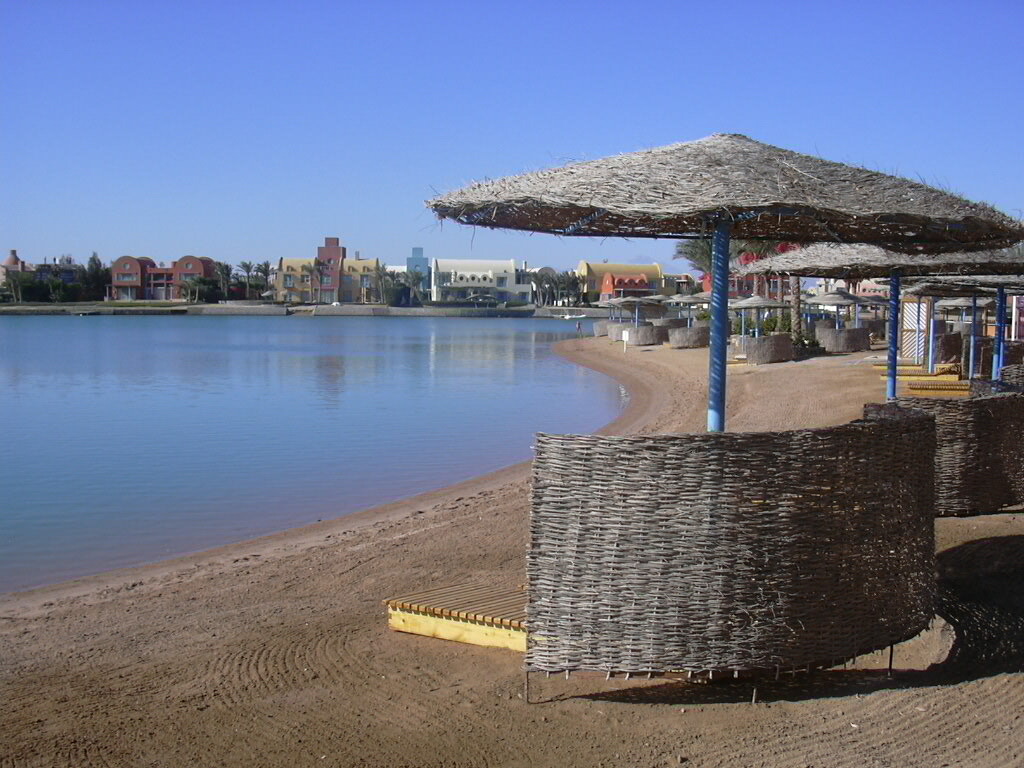
My beach.

I saw this on my walk and it made me laugh. I think this "protected by law" mangrove plant is quite lonely. I think all of these lagoons are human-made, likely man-made, there doesn't seem to be any Egyptian women here, not sure where they are. Not exactly sure how this mangrove plant got here but 1) it is alone and 2) it is protected by law.

The life guard chair at the beach. Looks a bit like a king's chair...pharoah I guess.

The beach for other people. They rake it.

The houses here are fascinating. I know nothing about architecture, though of course I'll soon be an expert since Giant Teenager No. 1 has been accepted into the architecture programme at the Univeristy of Botswana (!!yay!!). I think the house here are lovely. I intend to find out more about them. I'll let you know what I uncover.


So that's it for now. So far we are four writers: me, an Italian woman, a British/Sri Lankan via Cape Town woman and a man from Wales.

My Egyptian adventure has begun!!